Warhol is a true documentarian, even though he only documents his friends, lovers, and random strangers. Through fiction (exaggerated fiction), we reach reality – which is often physical cruelty, approval-seeking, and sex. In Camp, Jack Smith's performance suddenly makes us uncomfortable about the film's irony. It is no longer a performance – it becomes scary, and we see fear in the faces of the other people. Smith exposes the movie, forces the camera to move with him, demands that the microphone captures his voice. Suddenly, the movie becomes real – it is not play-acting any more; or perhaps the movie has always been real, and Smith merely exposes that fact.
Jonas Mekas mentions that Smith's plays seem to be able to go on even without an audience. The same can be said of Warhol's films. The film exists independently of us. To go even further, the audience merely seems like an intrusion into the film's space. I can imagine Warhol's films playing to rows and rows of empty seats in a silent theater – the films exist like specters, ghostly presentations (not re-presentations) of the people in them. It makes me realize that, first and foremost, the responsibility of a film is to exist. How people (or the filmmaker) judge(s) it, how the audience sublates it into its own consciousness, how it is communicated into the world is secondary. The film is its own object, it is the radical Inhuman (even though it uses human characters as the wood to fuel its fire). When confronted with Warhol's stoic, indifferent images, the audience is confronted with infinity, that which is insurmountable.
That is the experience of a person watching them today, a person who has grown up without experiencing any of the idealism from the 60s. More so than any other filmmaker, Warhol's films are fossils that embalm time. In Camp, for example, there is the real time of the 'revue,' but also the weight of all the time that has passed since the event. One cannot watch the film without noticing its anachronism, without being confronted with mortality. The people in his films are resurrected each time they pass through the projector. Suddenly, they are youthful again; they are watching us as much as we are watching them.
And then we realize that we do not watch the images, it is the images that watch over us. Even when we leave the theater, we remember that the images are merely kept away, waiting for a time to be taken out, so that they can watch us again. We grow old, but the images remain the same. They are the ones who have seen all of history (the history that I have not seen) – they have seen the end of the Vietnam War, the rise of the Reagan-era, the Gulf War, 9/11, and now the 'war on terror' – and they are the ones who will outlive us. Like Odradek in that Kafka story, 'The Cares of a Family Man,' their mere existence makes us uncomfortable. We realize that we are the Other, we are going to live out our pathetic existence, and then die.
It is a strange sensation, then, to see the performers in Camp trying desperately to hold on to the camera. Just one more second of screen time, just one more frame to prove their humanity, their existence, their freedom, before the unfeeling machine randomly pans/zooms away from them, and they are again left out of the frame and into death.
Friday, April 22, 2011

Thursday, January 6, 2011
Notes on Cinema Redux
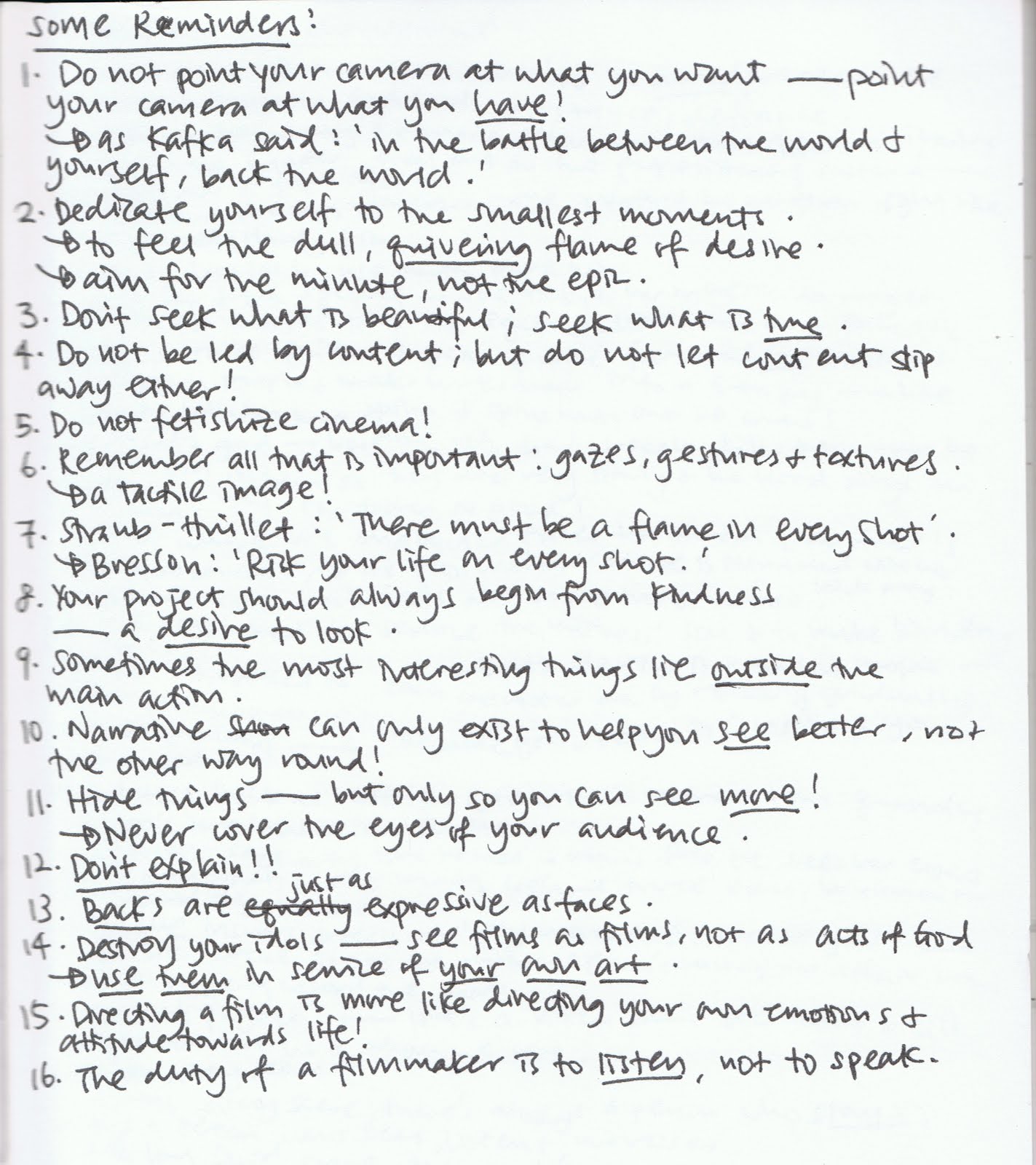
Seeing as I have changed so much since the inception of this blog, some reminders for the decade ahead might be useful:

Tuesday, January 4, 2011
On Doors (8): The Art of Distances
"Every form-of-life tends to constitute a community, and as a community tends to constitute a world. Each world, when it thinks itself - when it grasps itself strategically in its play with other worlds - discovers that it is structured by a particular metaphysics which is, more than a system, a language, its language. When a world thinks itself, it becomes infectious. It knows the ethic it carries within, and it has mastered, within its domain, the art of distances."
-- Text from "Introduction to Civil War" by Tiqqun
-- Text from "Introduction to Civil War" by Tiqqun
Tuesday, December 21, 2010
Year of 2010
My Inspirations 2010:
You Only Live Once (Fritz Lang, 1937)
Big Business (James W. Horne & Leo McCarey, 1929)
Dangerous Game (Abel Ferrara, 1993)
The Miracle (Roberto Rossellini, 1948)
In Vanda's Room (Pedro Costa, 2000)
Europa '51 (Roberto Rossellini, 1952) + Man With a Movie Camera (Dziga Vertov, 1929)
This Land Is Mine (Jean Renoir, 1943)
The Diary of a Chambermaid (Jean Renoir, 1946)
The Act of Seeing With One's Own Eyes (Stan Brakhage, 1971)
Jack Smith and the Destruction of Atlantis (Mary Jordan, 2006)
A Spring River Flows East (Cai Chusheng & Zheng Junli, 1947)
Shoah (Claude Lanzmann, 1985)
The Grapes of Wrath (John Ford, 1940)
Tropic Thunder (Ben Stiller, 2008)
Venom and Eternity (Isidore Isou, 1951)
Che (Steven Soderbergh, 2008)
Stories From the North (Uruphong Raksasad, 2006)
Film Socialism (Jean-Luc Godard, 2010) + Germany Year Zero (Roberto Rossellini, 1948)
Paraboles: The Art of Speaking (Emmanuelle Demoris, 2010)
Here and Elsewhere (Jean-Luc Godard, 1976) + Méditerranée (Jean-Daniel Pollet, 1963)
Vinyl (Andy Warhol, 1965)
Films completed 2010:
One Day in June (10 minutes, HD)
Rumah Sendiri (20 minutes, DV)
Night Lights (48 minutes, HD) + Death by Moonlight (5 minutes, HD)
Birth (10 minutes, DV)
Cotton (3 minutes, 16mm)
Works in progress:
Eclipses (120 minutes, 16mm)
No Images (40 minutes, 16mm)
Thursday, December 9, 2010


Friday, November 26, 2010
On Doors (7): Notes on Méditerranée
1. The circular repetition of images: images that regenerate themselves, but remain the same; silent witnesses, one replacing the other, one already watching the other even before the other has begun. ("The pieces of the game are picked up again. They will be re-diffused, different ones and the same, in the same way and differently.")
2. History: the accumulation of memory - forward going, but inwardly circular - leaving fragments, monuments, images, that seem to be able to speak, but stop before they are able to say their words. How do we reach the beyond, the infatigable - beyond the curtain of fact...who, besides the mute images, is left to bear witness?
3. Blindness: history blind to itself; images blind to each other; humanity blind to human beings.
Tuesday, November 9, 2010

Subscribe to:
Posts (Atom)
